.png)


SPOTLIGHT: DAVE HARRIS AKA DE HARRIS:

Updated: Mar 3

MUSICIAN
VOCALIST
GUITARIST
PRODUCER
BIO:

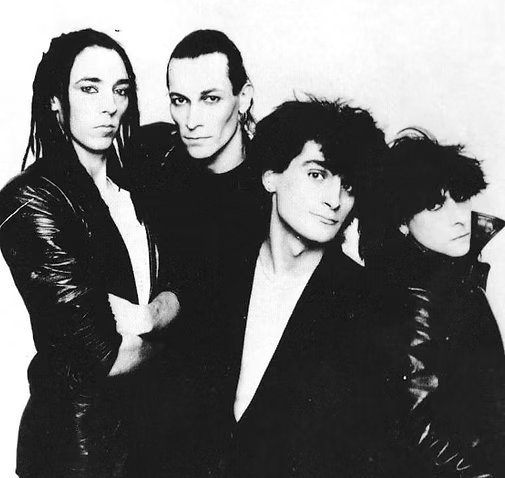
Dave Harris aka De Harris: is an exceptionally talented British songwriter, vocalist, guitarist and producer who occupies a unique and unforgettable place in UK music history. With an iconic look that defined the 80s musical era. Dave fronted the successful incarnation of the Birmingham new‑romantic band, Fashion.
He became the face and voice of Fashion’s 1982 era. Dave Harris worked closely with producer Zeus B. Held, whose glossy, futuristic production defined the album, Fabrique—a recently re-released digitalised De Luxe version is available. Later, he collaborated with late Pink Floyd (founding member and keyboardist) Richard Wright in the electronic duo, Zee, producing the album Identity. Dave Harris is a musician who embraced technology early, especially the Fairlight.
Harris moved through the decades like a quiet innovator, shaping pivotal moments that still echo in the shadows of British electronic music.
Q&As
DG Q: Let’s start by taking a step back to the very beginning. What sparked your musical journey? Was there a formative moment or early experience: perhaps in childhood that set you on the path towards your impressive musical journey?

DH: Hi DG, that’s very simple for many people of my age. My folks always listened to music in the house, various records, and the radio which was pretty dower, mainly requests for the Army and RAF who were still away in bases around the world. I didn’t really catch on to Rock and Roll, but the time came when the Beatles arrived Everywhere! Their music gave me a strange feeling all over, I later found out that it was the chills. I wanted to be John, Paul, George and Ringo! As did everybody. So, the journey began with a Ringo Starr snare drum. My grandfather was a drummer in a big band, and my mum and dad loved the fact that I was into music. Dad took me to buy a set of drums after a while from the high street in Aston, just down from the Ansells Brewery.

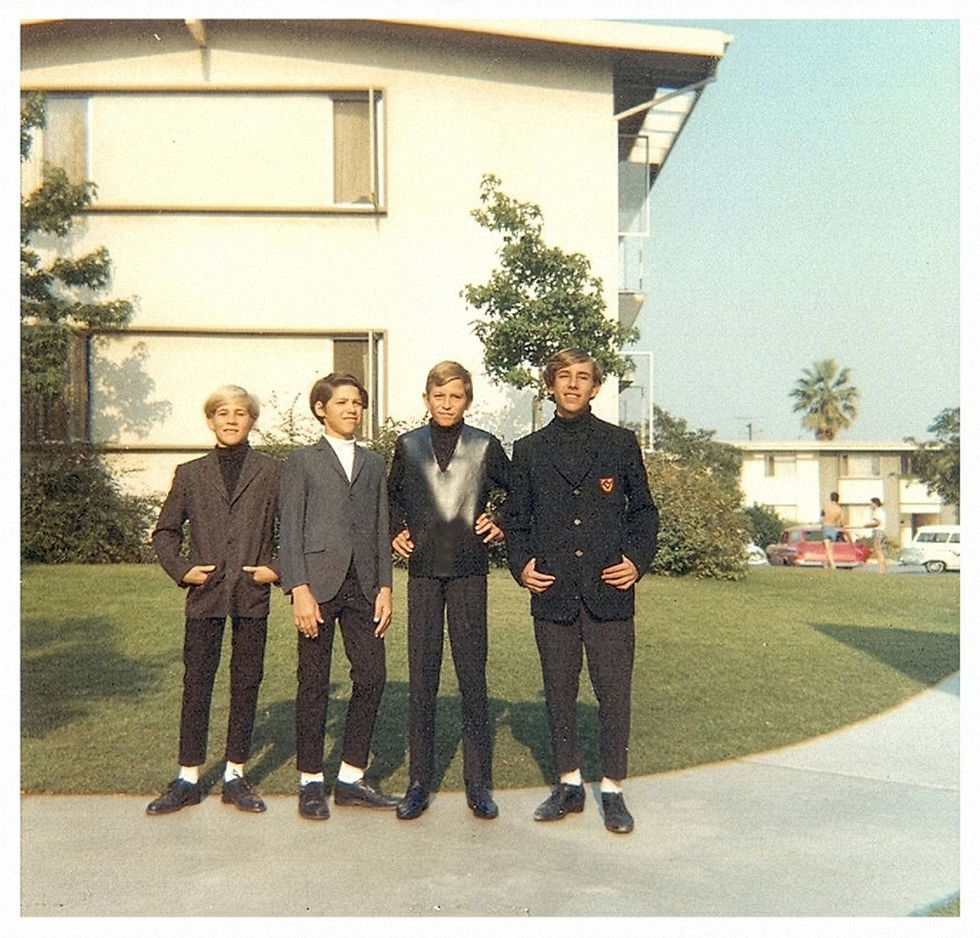
Soon after, probably 1964, our family emigrated to Los Angeles. My Grandfather, on my mother’s side, had moved there when she was a child. He became an actor and she wanted to get to know him, Dad was crazy for it! I won’t get stuck on this, because as a child at (11) it was a Brain F*ck. As we were driving from the airport, I saw a guy from the car window who was flying along on a board with roller-skate wheels on!
“Dad, I must get one of those, Tonight.”
“NO, we’re going straight to the hotel”…TBC.
DG Q: Before stepping into Fashion in 1981, you’d already explored a spectrum of sounds through a series of earlier bands: acoustic, funk‑driven, and R&B. Can you share more about these bands? And when looking back on those formative groups, which of them lingers most vividly in your memory?
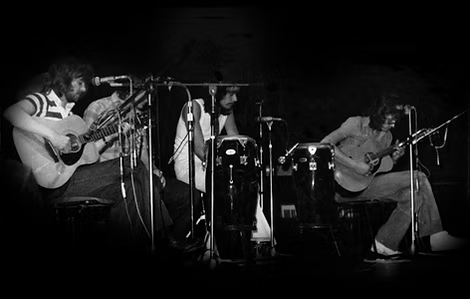
DH: There were quite a few bands that led the way, Fashion, at the start was a three-piece band. When I was still at school and still playing drums, I can’t remember the name of the band, but we played Cream and Jimi Hendrix tunes. That was a lot of fun, but I knew that I had to move on to playing the guitar and singing up front. Also, I had started listening to Black music, and that feel and soul really hit me. This was the period where I got married, 1972.
Sue and I bought a house on the Birmingham Road in Walsall, it needed renovating, and we did it with the help of some of my good friends from Tamworth. I had joined a soul band from Walsall (Soul Machine) who gigged at the US airbases around the country, and I guess it was my first experience of raw gigging. It was a large band, and we had to shift A B3 organ and Rotary speaker in and out and sometimes up and down outside staircases (seriously dangerous). We’d travel in an old diesel truck which liked to break down in the middle of nowhere in the freezing cold. It was a good experience but too hardcore for me, a good band though.

Then came the acoustic period, probably due to the American bands at the time i.e. America, The Doobie Brothers, CSNY, Joni Mitchell etc. So, my mates from Tamworth at the time, Colin Edmonds, Dave Bates, Adrian Cooke R.I.R and I formed (Indian Runner) two acoustic guitars and percussion. We built it on 4-part vocal harmony and the sound of the congas and the two guitars. We all loved it and started writing our own music as well as throwing a few well-known tunes.
At the time, there were competitions going on for electric and acoustic bands. We played a couple, one in Leeds where we won a recording session in Warner Chappell’s studio in London (very nice) and another where the final was in the Roundhouse London, it was really cool. We won the acoustic section.
We went on to record and play gigs until I felt that it was time to move into electric music.
David Clarke from Soul Machine and Colin from Indian Runner joined with me to form our

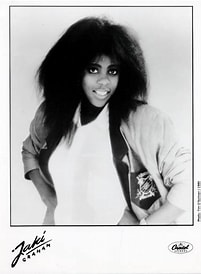
first Funk and Soul band (Bumpers) a seven-piece band. We had two horn players, which were hard to find, but it made the sound we needed. My missus was on backing vocals and collecting the money at the door! It was a fab band. The next outfit was called Ferrari. We were lucky enough to get Jacki Graham as a lead singer, the real deal. We also had a different drummer, a keyboard player, and a new guitarist, Jaques. We worked and rehearsed hard to get the sound correct and soon we started gigging to good results and a good following.
Next, I joined a band called ‘The Italians’ It came about from a couple of guys I knew who worked in Woodruffs Music shop. They asked me to join them, and it was good!
A great choice of music, great players, and a belting singer. I think we played mainly at the Barel Organ. Great crowds. One of these gigs was the first meeting with Mulligan and Dik.
With a lot of these bands, especially the large ones, it is very hard to get everyone to rehearsal or even gigs. That’s not good, but many people of this age are married, possibly even with kids, and you can’t really blame them for not making it all the time. Unfortunately, friendships have been lost because of that.
DG Q: When you stepped in to front the second incarnation of Fashion, the band shifted into its most commercially resonant era. The line‑up: (yourself) De Harris (vocals/guitar/writer), John Mulligan (synth/bass), Martin Recchi (bass), and Dik Davis (drums) that steered the sound from post‑punk edges into something sleeker, electronic. What drew you to the band: the forces, the encounters that set things in motion?

DH: The times were changing. The record companies weren’t interested in straight out Funk acts or Punk bands, and I was realising that I wasn’t moving forward towards a recording contract or publishing contract. When Mulligan and Dik turned up at the Italians gig, we had a chat (first time meeting), and they told me about Fashion. They said something jovial about we can’t play and we gob on the audience… Punk Joke, I imagine.
So, I saw an ad in Melody Maker, band Looking for guitarist, it didn’t say, but it was obvious it was Fashion. I called the number and we booked a time for an audition at the Holy City Zoo.
I turned up and it was a good vibe as we all met.

There was a bass player now, Martin Recchi, from another Birmingham Band called Dance. We shot the shit and played space invaders for a while, then went into a small room to start seeing what we could do together. Mulligan had a Jupiter 8, a Wasp, and maybe another computer – sequencer. Dik, I can’t remember, but I think he still had an acoustic drum kit which was soon replaced by a Simmonds Electric kit, and Martin on electric Bass. I think I was playing a Travis bean electric which I soon switched to a Gibson ES 335 (my favourite guitar and still is). We started jamming, and in a few days, we had a few ideas. But more than that, we were creating a distinctive sound that we knew stood out from
the others, and it wasn’t Bloody New Romantic... My Dad was in hospital and wasn’t doing well. I went across to visit him and told him I was going Pro, he said to me with a smile, “Don’t ever look back and think, I wish I had’ve done that.” He was happy as was Mum, they never said to me, “Why don’t you get a real job,” as a lot of my mates had been told.
Dad passed not long after… John Harris R.I.P.
DG Q: The shift to ‘De Harris’ was such a distinctive part of your artistic identity. How did that twist on your name first come about, and what prompted the change at that moment in your journey?
DH: ‘De’ came from being with a couple of friends of ours who had a little girl at the time. When we were together, and Mellissa was getting older and understanding the conversation, Sue, Dave, Nina and Lee became S,D,N,L. Re: the change it was nice to be D or De or Dee as it came out in the press.
David Harris sounds like a schoolboy to me and David makes me think my mum is calling me cos I’ve done something wrong.
DG Q: The band’s impressive artwork shaped by the eye of iconic photographer David Bailey, ensured Fashion had its visual identity finely tuned. What was it like spending time with such a legend behind the lens? And how did this collaboration come about?

DH: I must say, Mulligan’s artwork was a large part of the look and story of the band from when it was formed, long before I joined them. He was, and is, an amazing artist. There was always a font or a painting that he had done on the flyers, posters, and record covers that I loved. I had wanted to be a commercial artist and went to Sutton Art School to study that, but I met a lot of artists much better than me, and decided I would be a musician instead. It was great to have Mulligan’s talent for the band as it meant we had control of the artwork; it had to be like that.
Re Bailey— he was doing a TV commercial for Olympus cameras at the time, there was a competition, I don’t really know how the connection came about but we got the call that David Bailey was going to do a shoot for

our album cover and we were made up! I was in love with his wife, Marie Helvin at the time, and I had his latest book of her photos. I had to take it along to get his, and possibly her, signature. She was a no show, but Bailey was, and he was willing, the grumpy bastard.
During the shoot, which was really good fun, I was standing away from where we were supposed to be standing and he shouted “Oi Geronimo, over here,” that is the best piss-take I’ve ever received, and I’ll love it forever.
DG Q: You decided to leave fashion before the proposed world tour of the album Fabrique, was there a seismic moment that brought you to that decision, or was you simply ready to move onto pastures new?

DH: This was a major decision, and still, I have to question it. It’s the toughest question in this story. I’ve always said, when you are semi-Pro you can look at the charts and measure where all the bands are in the great story of fame, but when you are where you have always wanted to be you can’t, or at least, I couldn’t get a measure on it. You start to meet famous musicians who recognise you and call you by your first name, which is cool and I must say flattering. Putting that aside, there is a lot of work that goes into getting a recording contract which we did quite quickly. We were lucky enough to be given a worldwide contract with Arista, everyone was very happy.
We soon got into the preparation of recording our first album. We had a few numbers that we had demoed, but now we needed to master 10 excellent tracks. We started in Koln working with Zeus B Held, as soon as I met him in the studio, I knew we were going to make something completely different from the music of the moment. Being in Germany started the feel of what was to come, and for me, it was a learning from Zeus, the technicians in the studio, and the owner, Martin Homberg, a nice guy. We saw what could be done with the computers and sequencers by linking them together. Zeus owned a Sennheiser Vocoder, which appeared on most of the tunes, an unbelievable instrument. I bought a Roland GR-300 Gtr. Synth which when put through the synthesizer, screamed!
Anyway, long story short, we moved on to Paris just outside the city to a studio in the Forest of Versailles. Waaaaaaaa! It was a residential studio, so we could work as late as the technicians could stay awake. Zeus was friends with the guy who ran it, worked the mixing desk, and was a chef with a great taste in red wine. Everything was falling into place. Here, we finished the bulk of the album and decided on the name, Fabrique. We returned to

London to mix the album in Utopia studio, Primrose Hill. Another studio with three studios, cutting room, and a great toilet for recording snare drums. We finished ‘Move on’ and Zeus and I went to another studio to record the Lead Vocals, I don’t know why, maybe we were behind schedule. I can’t write here the story of the mixing of the album in Utopia, but it turned out excellently, with an unexpected twist which were the remixes and dub tracks. In the meantime, Zeus and I went back to Paris a couple of times, must have been for some other mixes, I guess.
We released Fabrique which went in at number #10, I don’t think we, or the record label, were expecting that, four singles with 12” dance versions, Move On, Street Player, Love Shadow, and Something in your Picture.

We did a small tour of the UK and then went to New York where ‘The New Music Seminar’ was happening, and as a part of that we played two gigs at Webster Hall, Manhattan and one in Philadelphia. Cool Happening at Webster Hall, Afrika Bambaataa was standing at the side of the stage and as we came off said, “Hey man you’re band’s cool” a great rap artist of the time. Another great happening at the same time, as we left the stage, people started crazy dancing, but very cool, the birth of Break Dancing.
I had some very interesting meetings at the seminar, and without explaining or naming anybody, this was the moment when I realised that I had to make a decision about my future. We got back to the UK, we had a TV spot to do, that was going to be my last gig with Fashion. Not easy. I knew there was going to be a shit storm with the band, management, and record company.
DG Q: In recent times, you teamed up with Zeus B Held (the producer of Fashion Fabrique) for a Fabrique re-release: The digitalised recordings: 'Fashion Fabrique De Luxe’, can you expand on this? And what else do the two of you have planned going forward?

DH: Well, I had released the box set of ZEE Identity a few years previously, which I’ll talk about further on. So, I decided to put together a box set of all the Fashion tracks that we recorded, plus all the remixes and extended versions. It was a lot of work finding the master tapes, which my good friend, Paul Fishman (Reflex), helped with and getting them digitised. Paul and I have been working together since 85, and it don’t seem a day too long! We had started re-mixing the tracks which were really good, they came from 1\4” tapes and it was quite amazing what the digitisation had done, very clean, and perfect to work with the modern compressors effects etc. I didn’t want to affect them too much, just beef up the bottom end.

We ended up with four CDs’ three from Fabrique and one that Zeus and I put together for the gig we were playing in a Birmingham club, ‘Only After Dark’ Sept 24th, 2019.
Zeus and I started writing together, and have a few ideas that are unfinished at the moment, but I’m sure they will be released at some date soon.
DG Q: Your collaboration with the late Richard Wright (Pink Floyd founding member & keyboardist) on the ZEE album, Identity, remains a fascinating chapter in both your careers. How did that partnership come about?”

DH: ZEE came about from a meeting I had in New York. Somebody mentioned that Rick had left the Floyd. He was looking to form a new band, something away from Floyd Music and he was looking for a guitarist. So, when I got back to the UK, Rick and I had a get together and then organised a couple of jams in a rehearsal room in London with other players that he thought would be a good choice. Great players all of them. But they were either busy, or doing sessions, and unfortunately, it was hard to get them together. Rick and I were getting on well, and saw there was a problem getting everyone in sync. So, we decided it would be easier if the two of us wrote the album and maybe brought the players in for recording and touring (which Rick wanted to do).
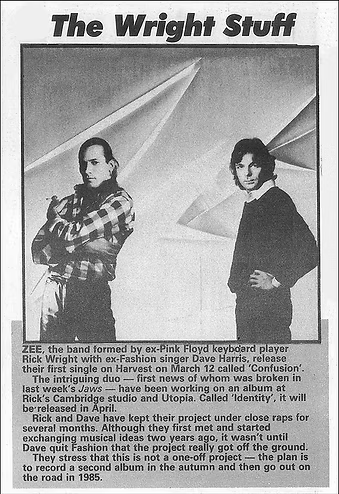
At this stage, Sue and I had been driving in from London to Royston where Ricks Rectory was. A beautiful place in a very quiet area, plus Rick had a very nice recording studio. Rick asked us if we would like to move in while we were writing the album, which we accepted. Rick had a guy who lived in, and did various jobs cooking etc called, Pink! Can you believe it… A great character who couldn’t help you enough. I used to work long hours in the

studio, and one time, at about 3:00 clock, he burst through the doors announcing, “Banana Bread,” holding up a lovely fresh cake… Sue and I loved him. I think we stayed for probably nine months to a year, certainly over a Christmas, which was fun. We managed to have a getaway to the South of France (Grasse) for a couple of weeks where Rick had another beautiful place where we intended to start writing lyrics. I seem to remember that didn’t happen, but there was plenty of other recreation. When we got back to the Rectory, it was time to tie things up and move back into London to start Mastering ‘Identity’ again in Utopia Studios.
DG Q: All the lyrics for the Identity album were penned by yourself, and superb lyrics they are too. Where did you draw your inspiration from for this album?
DH: That’s very kind DG, I always find this question hard to answer. I write and record the music first. I can’t allow the lyrics to get in the way of the beat. So, as I’m constructing the track, I start to feel a vibe and can start at least the chorus vocal and melodic hook (very important). I can’t really explain how the
verse lyrics appear, sometimes it’s very hard. It’s not my favourite part of the process because I enjoy the music so much. I am a Gemini as well and I can love a track then hear it in a couple of days, don’t like it, and bin it.
I think if there was a subconscious inspiration in the lyrics it will be about what was going on at that time (it was still a really big thing to have left Fashion, and be working and close friends with a major player from Pink Floyd)
Rick never made me, or anyone, feel beneath him. He was a real down to earth, beautiful guy.
For me, my favourite song from the Identity album is, ‘Seems We Were Dreaming,’ it’s so beautiful and reaches deep. When you revisit Identity now, is there a particular track that echoes for you? One that carries a memory, a feeling, or a moment in time that’s stayed with you?
DH: I like ‘Cuts Like a Diamond,’ I check that out quite a lot. You might not believe it, but that was the first time I had recorded a rock guitar solo in my life.
A friend from Arista, who had kept in touch, asked if I would play his silver Fender Strat on a solo, so we set up Marshal Cab, a Marshal head, and various ambient mikes to get things cooking. Oh, I forgot, the gear came from Pink Floyd’s storage unit. I mentioned to Rick that I needed a Minimoog, within an hour, a folder with a list of equipment arrived in the studio. It went from amps, to an ironing board for backstage, there was everything not once but: “Have you got a Minimoog there Rick?”
“Yes, there are four, how many do you want?”
Anyway, getting back to the solo, I don’t think we spent long on it apart from getting the sound right, and as soon as I had mastered controlling the feedback We had it. I loved it!
DG Q: The band name, ‘Identity’ is quite genius I thought. Can you explain for my readers your thought process behind the title creation for the album?

DH: ‘Identity,’ I remember well, and us deciding on it. We were at Rick's Kensington house relaxing in the lounge. No computers, so I was on the floor with a pile of Letraset, silver card and a Stanley knife designing the front cover. New bands used to put a load of different names in a hat and pull them out until they decided. I can’t remember which of us came up with the name, it doesn’t matter, it was perfect. We had both left our bands and this was our Identity.
DG Q: How did the use of Fairlight’s sequencing software shape the sound of the Identity album?
DH: In hindsight a little too much. It was the new sampling synth, a ridiculous price, you could do on a watch now what that did at the time. Rick had one, but he hadn’t mastered it because you had to type all the information in and that was a nightmare. I wondered why he had it on the floor covered up. Anyway, we thought we should at least have a go. It came from a company called, Syco, who appeared after a phone call with a beta version of a sequencer called Page R. It was simple, choose your sample i.e. Saxophone, press the go button, and after your one bar count in, start playing your part on the keyboard. You could also make your own samples of pretty much whatever you wanted. Although, the sampling quality wasn’t that good, and without realising it, that Fairlight sound would stand out against everything else on the album. I don’t think it bothered us so much at the time, but we got called out for it. There is a new generation of Floyd fans who pick up on the album, and it doesn’t seem to bother them, and I can live with it because it was an 80’s sound.
DG Q: Following on from Zee, you began writing, recording and producing other artists. Can you share more about this: partnerships, collaborations and artists?

DH: when we had finished recording ‘Identity’ I was offered the job of co production of
Limahl’s 1st solo album with Tim Palmer who had moved up from Engineer to Producer. Rick and I got a good deal from Harvest EMI for the album and we split it 50/50. Rick wanted to move the studio down to Grasse and start a new album. That was an amazing offer which I would love to have taken, but the writing and recording of Identity had virtually cleaned me out financially. So, producing Limahl’s album would help fill up the coffers. I think that upset Rick, but I also needed to expand my writing and production skills. I did another production or two with Tim, and this was at the time I started working with Paul Fishman. He was living in West Hampstead and had a small studio setup in a spare bedroom with some excellent synths and a Linn Drum (Sexy)! We worked on a few things with Roly, R.I.P. Reflexes’ drummer who was already working with Paul on some great music.

In a short time, Paul moved to a new house and had a studio built on the back. When it was complete, we got into the roll of writing and production mainly for ourselves at first, so we could realize our own sound. It appeared quite soon because we both had the love and feel for Funk & Soul music.
We worked with various female artists Yaz being one, I think we spent quite a few months writing tunes for her upcoming album at the time. I know we went through a long period of working from Midday to 2 or 3 am. One or the other of us had to bring sweets in the morning. It’s the rules! We are still very close and get together when we can in London.
In 1990, my publisher asked if I would like to go and write in New York for a month, I jumped at it and stayed. Lots of writing, Fred from the B’52’s, (That was tough), a couple of film tracks, and again various female artists. I was offered a production job in Rio De Janeiro in 1996 never had I been there but decided to take the job. Something else came up in 1997, so I moved there until 2000, then back to London.
DG Q: When you look back across the arc of your incredible musical life, is there a single defining moment—a flash of realisation, a turning point—that you now recognise as the one that changed everything for you?
DH: Well, it goes without saying that the Beatles were a defining moment for a boy who hadn’t even thought of what he might be in his future life, to a boy who knew he had to learn a craft— and that was music. I think that answers that question. But once I started playing the guitar and drums, there was another major flash of realisation, Jimi Hendrix arrived from Mars. It was a turning point... I had to Master the Guitar. I have to say, and I’m not shy in doing so, I was in love with Jimi, part Cherokee Indian, part African American. He didn’t sing because he hated his voice (Crazy) but he spoke most of his amazing lyrics and it was beautiful. Unfortunately, on the 18th of september, 1970, Jimi died at 27.
I was 17, and didn’t know what to do with myself.

Luckily, his son arrived from Jupiter: Prince Rogers Nelson (PRN, The Kid). I managed to get his 1st two albums. This kid played every instrument in the studio, he wrote some seriously sexy lyrics, and he played wicked guitar. He was arriving to play a one-off gig at the Lyceum in London. When he came on stage to one of his sexier numbers, he was wearing black heels, black hold up stockings, a black G-string, and a raincoat. He was here to make his mark.
The musos who were standing in a line at the front of the stage, took a step back in fright, I think. He was Jimi’s bastard son, here to finish off what Jimi had left behind. Turns out that he was a master musician and would make his mark on the world in the next couple of years. I met him in the south of France, where he was making his second film, ‘Under The Cherry Moon’ (More of that another time). Again, a star passed. April 21st 2016 at 57.
DG Q: You’ve always struck me as an artist who instinctively thinks outside the box. Was that always part of you? Maybe even before your musical journey began—or did it emerge as your artistry evolved?
DH: Thank you D.G. I think I do that naturally. I feel if you try to do something
a little different purposely it shows. I taught myself to play the guitar over the years and not blowing my own trumpet, I have had a lot of compliments on how I play the guitar. First
off, I’m left-handed. We thought when I got my 1st guitar in the USA that it would be a game getting a left-handed guitar. The guy in the music store said, “Play right-handed. Use your left hand to do the work on the neck, and your right hand to strum…" It made a lot of sense. I can hear guitar players saying, “ah but”… So, there is a difference in how I hit and pull the strings.
‘Fabrique’ a little outside the box, was ahead of its time, and is probably why it was picked up by a certain group of listeners. It stands up well today without too much 80’s sound.
I hated being called, ‘New Romantics.” We weren’t in that Clothing Line!
DG Q: How do you envision the future landscape of your musical path evolving 2026 and onwards?
DH: Well, I’m reworking some tunes I did with my mate, Colin, (from Indian Runner). It’s a project that never got finished and it’s a different vibe. Also, I am planning to do a few videos for those numbers on ‘Fabrique’ that didn’t get one.
And of course, ‘Identity’.
I like the idea of film being included with music, it’s a skill I need to learn over the next few years.
DG Q: You’ve achieved so much throughout your remarkable musical career. But tell me… is there an unrealised dream you’ve kept tucked away, waiting for the right moment to bring it into the light. One that lingers in your mind, quietly calling your name?
DH: To Be Answered… TBC…
DG Q: What’s one thing your fans would never guess about you that you’d be willing to share?”
DH: Hmmm. We both wish that we had had children.
DG Q: If there was one piece of advice you could offer to emerging artists today following in the same path, what would it be?
DH: Always keep practising your instrument, and remember, there is always someone better than you that you can learn from. Gig as much as possible. I know that is a tough one these days as a lot of venues have closed down. More than anything, believe in your soul and press on.
DG Q: What is the one piece of advice you wish someone had shared with you when you started out on your musical career?
DH: I think it didn’t matter too much when I started my musical career, when you are semi-pro you all stick together and find a way to get to the gigs, do the gig, get home (not quite as easy as that). And as it goes along, you start thinking of the possibilities of getting a record deal, will it be with this band, who doesn’t want to leave his job, who would, or are you by yourself? I would say, if and when you get a record deal, take very great notice of where the money is going all along the way!
DG Q: To close on a powerful note, is there a single quote or line: your personal compass that captures the essence of who you are? The one that says, “This is me.”
DH: That’s a tough one. I think my one quote would be, “It’s got to be sexy.”
Music has such an effect on people, probably more than anything, that’s probably why I compose the music first. If you have done the lyrics, it’s very hard to go back to the tune and Sex it up.

LINKS:
FB: Facebook
Instagram @fashion_fabrique
Where to buy Fabrique De Luxe Album 2025 re-release:




Comments