.png)


SPOTLIGHT: SIMON COX


AWARD-WINNING
FILM DIRECTOR
WRITER
EDITOR
BIO:

Simon Cox is a Midlands-based accomplished and ambitious UK filmmaker, whose career spans 30 years from early Super 8mm films to large‑scale independent sci‑fi features. His commitment to long‑form storytelling, distinctive creative vision, and sustained contribution to British genre cinema have earned him recognition at home and abroad, establishing him as a notable voice in the UK film landscape. Described by The Guardian as “a ludicrously ambitious filmmaker,” Simon’s journey behind the camera began early at 14. In 2005, the Horror Channel hailed him as one of the UK’s most exciting emerging directors when they premiered his debut feature, Written in Blood, featuring Sharon Small. Since the early 1990s, Simon has carved out a career in British film and television as both editor and director, bringing his eye and instinct to countless projects, and completing two feature films along the way.
Q&As
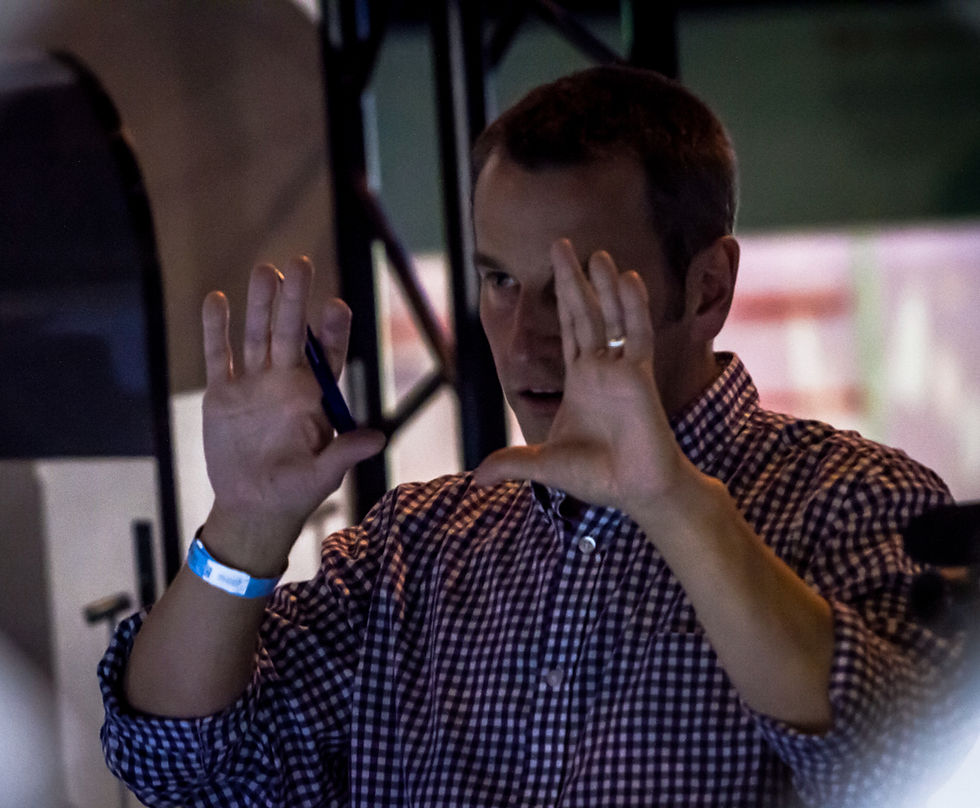
DG Q: Before we explore the incredible filmmaker you are today, I want to drift back to where it all began. What first stirred your eye toward the lens? Was there an early spark, maybe a fleeting childhood moment, that set you on this long, impressive path into film?
SC: Well, hello there…
I remember being around 3 years old and seeing an early episode of Star Trek. It was the one where Spock lost his brain (I know, these things do happen), and the crew had to find it. It was around 1968, and we had recently got a colour TV. I was blown away by the colours, the sound, and the fantastical vision.

My parents were about to split up, and there were constant arguments and tension in the house. Star Trek and Doctor Who gave me something magical and hugely creative to focus on. I think the moon landings in 1969 helped too—the idea of what could be out there just blew my mind.
I always felt different from the other kids, and shows like Doctor Who, Star Trek, The Six Million Dollar Man, Land of the Giants, and Voyage to the Bottom of the Sea gave me a place to escape. Looking back, they encouraged me to daydream and come up with my own stories—distant lands and strange alien characters.
In 1977, my world changed when Star Wars hit cinemas. I could write thousands of pages about how it affected me—but from the first moment I saw it, I knew I wanted to do what George Lucas had done: create movies that move people in the same way. Nearly 50 years later, that desire has never left me.
DG Q: Your impressive 30-year filmmaking career traces back to age 14, when your first super 8mm film, Battle in Outer Space, was featured on the BBC programme Screen Test. At 16, you produced a second film, Circles of a World, which was commended at the 9th Tokyo Film Festival. Can you share more about this?
SC: As a young teenager, I became fascinated with filmmaking. My mother had a great imagination and had done some writing herself, I think she understood me and encouraged my passion.
When I was 14, she bought me a Super 8 projector and cine camera. That was massive for me—and I was off!

A few weeks later, I made my first film, a six-minute sci-fi epic called Battle in Outer Space. I pinned black sheets to my bedroom wall and splattered them with white paint for a star field. I made cardboard spaceships and dangled them in front of the camera. The results were terrible—out of focus, badly lit—but I could see the potential.
The BBC ran a children’s film show called Screen Test, and I sent them the film (yes, the master!). They showed a few seconds and mentioned me—I was gobsmacked. It made me the talk of the school (for about a day!). Thankfully, they returned the film with a lovely letter.
I made lots of Super 8 films as a teen—it was my filmmaking education.
In 1983, I made Circles of a World, a 35-minute sci-fi time travel film where aliens come back to 1980s Britain to wipe out mankind. We built spaceship sets in bedrooms and shot a big finale in a forest near Basingstoke. It took nearly a year to make.
I entered it into a competition—it ended up in the 9th Tokyo Film Festival and won an award. That gave me a huge confidence boost and pushed me toward becoming a professional filmmaker.
DG Q: You began your career editing children’s television. Which programmes did you work on, and how did that early experience influence your development as a filmmaker?

SC: I moved to London at 22 and got a job as a runner at FilmFair. Within a year, I moved into editing and worked on shows like The Wombles, The Dreamstone, Rod n Emu, Treasure Island, Huxley Pig, Bangers & Mash, and Astro Farm.
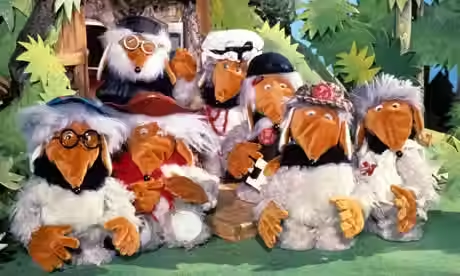
It was an incredible learning curve. Editing taught me the power of storytelling. We cut on film, not video, which was fantastic.
I also worked with some amazing talent—Bernard Cribbins, Martin Jarvis, Rod Hull, Dawn French, Richard Attenborough, Rik Mayall, Richard E. Grant, Hugh Laurie, Robert Powell, and Helena Bonham Carter to name but a few.
DG Q: Your debut feature film, Written in Blood, arrived on the screens in 1998—a British horror film featuring Sharon Small and Grant Masters. (a brilliant film that I loved). Securing two well‑known actors for a first feature is no small feat and very impressive. How did you bring them on board? And for the benefit of my readers, what is the film about?

SC: I loved editing and the invaluable skills I learnt at FilmFair stood me in good stead for many years, but I really wanted to make feature films, and my goal was to write and direct sci-fi movies. However, in the 1990’s making anything sci-fi was hard – and expensive. In my research, I’d seen that a lot of established directors had started out by making low budget horror films so making a horror film made a lot of sense.
In 1994, I wrote a script called Driven (later to become, Written in Blood). It was a story about a famous horror author, Martin Harris, who seeks help from his recently dead brother to complete his new novel, Driven. However, Martin soon discovers that it wasn’t his brother who has helped him. It was a Victorian serial killer called, Dr McRayer. The novel becomes a smash hit, and Martin must stop McRayer coming back from the dead to wreak havoc on mankind.
I made a 3-minute teaser pilot for the film at Pinewood Studios and then took it around UK distribution companies to see if I could get it funded. It took a while, but eventually, a company called, Dandelion Distribution, gave me a break. The company was owned by Talking Picture TV legend, Noel Cronin. At the time, Noel had a 3-picture distribution deal with a US film company. He had delivered two films, and had a little money left and needed to produce a third. I think I entered his life at the right time and Noel commissioned me to make my film.
With a budget of $200k, I set about building a team and finding a strong cast of actors. Because we had a budget and a strong distributor behind us, we were able to get some impressive cast on board. Initially, I went to Michael Caine’s agent to see if he would be in the film. She laughed saying, “not a chance. However,” she continued, “We do have Patrick Robinson who might be interested.”

Patrick played Ash in the TV show, Casualty, and was excited to be in the film. Having him involved really gave the film some credibility and before long we had some powerful actors; Grant Masters, Paul Copley (A Bridge Too Far), Sharon Small, Doug Bradley (Hellraiser) and Frances Magee (Star Wars Rogue One.)
This ultimately, was a very difficult film to make and pushed me extremely hard. I was never completely happy with the final film, but looking back, I know I gave it everything and I am very proud of it. Nearly 30 years later, I managed to buy the rights back, so I’m pleased to say that I now fully own the movie.
DG Q: Invasion of Planet Earth, your second successful feature film, brought large‑scale sci‑fi action to the screen, featuring, Simon Haycock (The Invaders) Toyah Willcox (Singer/Songwriter), Lucy Drive (House of Evil), Julie Hoult, and Danny Steele (Residue) to name a few. You even brought in real military hardware & soldiers into Birmingham’s city centre, plus 900 extras. Film Birmingham, the Council’s film office, were very accommodating! Can you talk us through the scope of that production and what it took to pull it off?

SC: Written in Blood had been such a tough experience that I decided that if I was going to go through all that pain again, it would at least be on a film that I really wanted to make – and that was an ambitious sci-fi epic.
It was around 2003, and I had written an early draft of the script. I took it around the film industry, but no one would bite. I ended up spending years pushing business plans out to investors, but it was just so hard. In the end I turned to crowdfunding. I couldn’t raise the full amount, so decided to shoot it in sections. Ideally, raising funds, shoot a section then raise more funds and just keep going until the film was done. It made sense – how hard could it be…?
I knew I needed a big crowd of supporters around me so decided to shoot the big action scenes where crowds flee from the attacking spaceships, first. Film Birmingham allowed me to shoot the scene in Central Birmingham and after lots of promotion on Facebook and

Twitter, over 900 Brummies’ turned up to be in the final movie. This set the bar high and lots of people signed up to come on the filmmaking journey with me.
Invasion Planet Earth ended up taking around 10 years to complete. We ran seven crowdfunding campaigns, and I also managed to attract some bigger investors to help finance the rest of the movie.
Looking back, it was an incredible journey, we ended up creating some huge battle scenes with tanks, soldiers, huge crowd scenes, alien planet scenes and zombie scenes. It was brilliant and I am so proud that we did it.
DG Q: Staying with Invasion of Planet Earth, the film attracted substantial attention both in the UK and internationally, generating coverage across television, print, and online outlets. What factors do you think contributed to that level of visibility, and how did you navigate the media response?
SC: When I first completed the movie, I took it to almost every UK film distributor, and again, no one would bite. I was worried that I might not actually find a company to help me get it out there. Eventually, I found a distributor prepared to help. Lightbulb Distribution, did an amazing job. They pushed it out everywhere. We got a UK theatrical release and a great DVD and digital release.
They introduced me to a distributor,
who released in the US and Canada.
From there we sold it across the world where it got cinema releases in Japan, South Korea and Australia. It was so exciting; however, it was released just a month before Covid, which really hit us hard, destroying most of our larger theatrical plans. The film did well on DVD and eventually on digital streaming.
DG Q: The film was originally titled Kaleidoscope Man. What led to the decision to rename it Invasion of Planet Earth?
SC: Just before we released the film, the distributor suggested that we re-title as they felt it would have better success with a more commercial name. I fought it for a while but knew that the distributor understood the market better, and I needed this film to work. So, after a few sleepless nights, changed the title to, Invasion Planet Earth.
DG Q: Filmmaking demands skill, and a great deal of passion which you have in abundance. Looking back over your career, what has been the most challenging part of that journey for you?

SC: I’ve always had a lot of energy, and nothing excites me more than coming up with an idea, filming it, editing it and then showing it to an audience. It’s got a lot easier to make films recently, we all have phones with camera and can edit on free software. When you make films professionally, you need a team of people to support you and of course, these need to be paid for. In a nutshell, the most challenging part has been investment. Money money money!
DG Q:

Your current project is your third feature, the sci‑fi film Of Infinite Worlds, due for completion in September 2026 and featuring a sizeable ensemble cast including Lorena West, Marc Bayliss, Sean Cronin, Florence Dawson, Rico Morris, and Flora Dawson. What can you tell us about the film and the scale of this new production?
SC: After the success of Invasion Planet Earth, I wanted to go bigger and better with my new film but as yet, haven’t received the call from Hollywood. So, it looked like I would have to keep the budget low and be smart in the way this one was made. Over the last few years, filmmaking technology has exploded and it is so much easier now to make bigger films and create amazing special effects than it was when I made my last film.
We assembled an incredible cash of British actors, built a variety of spaceship sets and shot the film in 2024. Over the last two years we have been putting the film together and creating the amazing special effects.
Of Infinite Worlds is a huge, sprawling sci-fi adventure. I don’t want to say too much about it at this stage, except – prepare yourself for something fantastic. If you love science fiction from the 60’s. 70’s and 80’s, this film will thrill, inspire and move you like nothing you’ve ever seen, and I can't wait to unleash it upon you!
DG Q: One thing that stands out about you is your consistently positive, energetic approach to your work. So much so that it is highly contagious. Where does that drive originate from?

SC: Thank you for saying this and honestly, I’m not quite sure. One thing I can say is that as a spritely 60-year-old, I have just as much energy and passion as I did when I was 16. I think it all harks back to the excitement I felt when I first saw the original Star Wars. That ignited something very deep, almost carnal within me that I’ve never lost. I still get excited about films and filmmaking and nothing makes me happier that creating some shots and then cutting them together. I still think it’s some sort of magic!
DG Q: When you look back across the arc of your incredible filmmaking career, is there a single defining moment, a flash of realisation, a turning point, that you now recognise as the one that changed everything for you?
SC:

There have been lots of defining moment, but I think the big one for me was leaving home and moving to London. If I hadn’t done this, I would never had worked in the film industry which taught me so much about films and film making. It also gave me the confidence to really raise the bar high in my filmmaking endeavours.
DG Q: How do you envision the future landscape of your filmmaking journey evolving going forward?
SC:

I’m not sure but one thing I can say is that I feel like I’m just getting started and my best work is definitely not behind me. I’ve wanted to make movies all my life, and from me, the best is yet to come. Watch this space!
DG Q: You’ve achieved so much throughout your remarkable filmmaking career. But tell me… is there an unrealised dream you’ve kept tucked away, waiting for the right moment to bring it into the light. One that lingers in your mind, quietly calling your name?
SC: Yes, there is one. I would really like to have one crack at making a big budget movie. Lots of money, big screen talent and working with some of the best technicians on the planet. I have a gut feeling my new movie, Of Infinite Worlds, might finally put me on the map – and if it does, I am fully ready to take on something big bold and beyond spectacular. Wish me luck!
DG Q: If there was one piece of advice you could offer to emerging filmmakers today following in the same path, what would it be?
SC: Build your own audience with social media. The distribution world has been flipped on its head. Nowadays, a young filmmaker can make a feature film and put it on streaming platforms across the world. Building your own loyal fanbase will help you finance your film and get it seen. Trust me on this one! Another piece of important advice goes with this: Make sure you look after your audience. Keep them updated and treat them with maximum respect. If you do this, they will support your career forever.
DG Q: What is the one piece of advice you wish someone had shared with you when you started out on your filmmaking career?
SC: Stop waiting around for someone to discover you and give you a big break. The calvary isn’t coming to save you and you don’t need permission to do the things you dream of. Make the decision to do something, create a plan, then do what needs to be done to make it happen. Believe in yourself!
DG Q: To close on a powerful note, is there a single quote or line: your personal compass that captures the essence of who you are? The one that says, “This is me.”
SC: Tenacity is the key and whatever life throws at you - never ever give up. If you don’t believe in yourself, who will believe in you? To quote Invasion Planet Earth, “Trust in your hopes not your fears and whatever you do, be spectacular!”
Go get ‘em guys!
OF INFINATE WORLDS IS DUE FOR RELEASE AUTUMN 2026
LINKS:
Website: https://www.ofinfiniteworlds.com/
TikTok: @simoncoxmoviemaker


Comments